Winter 2023
The 2023 Quality Payment Program: Updates for Anesthesia
Bryan Sullivan, MSHS
Chief Quality Officer, Anesthesia Business Consultants, LLC, Jackson, MI
The Merit-based Incentive Payment Systems (MIPS) program is entering its eighth year of operation, and it is still a hotbed of confusion, anxiety and—depending on whom you ask—misinformation. This is largely because participation in MIPS is extremely dependent on the specialty, the group, the reporting option and the clinician’s commitment to continued participation. For the past several years, providers were offered an exemption to the program due to the COVID-19 pandemic, but 2023 will not likely continue to enjoy this backstop. To help dispel some of the stress with navigating MIPS, this article will walk through the requirements of 2023 reporting and be a resource to review if you have any questions about how you need to participate next year.
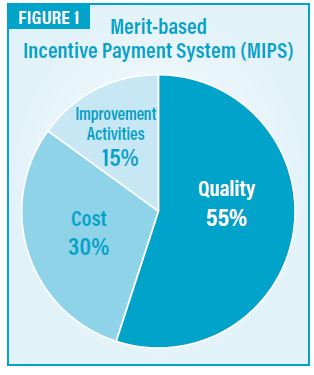
MIPS Category Review
At the high level, there are only two categories that need to be considered under MIPS: Quality and Improvement Activities. These two categories comprise 70 percent of your overall MIPS composite score, as Cost is automatically calculated by CMS, based on your billing.
When added together, these three categories must total 75 points or more to avoid a penalty in 2023. For example, at the end of the year when each category score is calculated, and your results are 80 percent in Quality, 100 percent in Improvement Activities, and CMS awarded 75 percent in Cost, your total would be as follows:
If the total score is above or below the 75-point threshold, bonuses or penalties will be assessed on a linear sliding scale. If this looks a little daunting, you may be excluded from the entire program if you bill less than $90,000 in traditional Medicare allowed per provider. If you are curious about your status, click here (https://qpp.cms.gov/participation-lookup) for the MIPS participation lookup tool.
Now that we have a general understanding of MIPS at a high level for next year, let’s look at some details.
Category Details
 Thankfully, little has changed within each category for 2023. For example, the data completeness requirement remains at 70 percent for Quality category reporting, meaning clinicians will need to report on 70 percent of each measure’s eligible population to be counted. The big news is that a widely reported Quality measure will be retired. MIPS 76 (Prevention of Central Venous Catheter - Related Bloodstream Infections) is no longer an eligible measure because most clinicians were compliant and therefore didn’t differentiate “good” providers from “bad” providers. This will affect all anesthesia providers that were planning on using the Anesthesia Specialty Set to report and comply with the Quality category. The specialty sets were useful in previous years, but as we will see, a better pathway exists with the MVPs! Additionally, several Improvement Activities were retired for 2023, but this may not have a material effect on anesthesia providers due to some other changes within the program.
Last month, CMS finalized the 2023 measures for all of medicine. You can review the specifications here (https://qpp.cms.gov/participation-lookup) to download the official list and details. For our registry, we can report on the following measures:
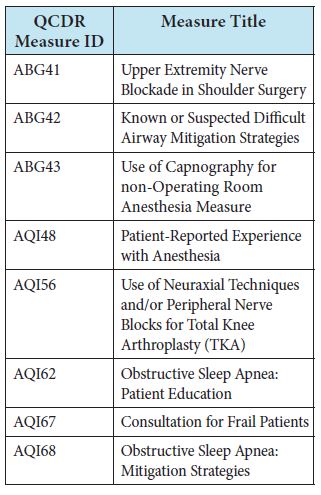
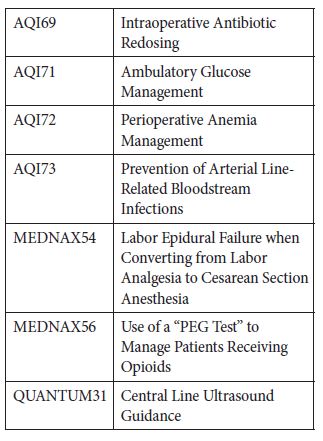
For those who are a little more interested in some of the details, the three point floor for measures without a benchmark has been removed. This served as a point floor for any providers reporting QCDR measures that were not widely adopted in the industry; but, again, this will not likely have an effect on any anesthesia providers moving forward.
The one other detail important for anesthesia providers is to confirm your Non-Patient Facing status with CMS. This status exempts anesthesia clinicians from reporting the Promoting Interoperability category, which is the old “Meaningful Use” program. The reason this is important for 2023 is that CMS will not automatically exclude CRNAs with this status; and, if you are identified as a patient-facing clinician, we need to review this special situation. We will be proactively checking your status; but, to confirm your own status, click here (https://qpp.cms.gov/participation-lookup).
If all of this seems a little overwhelming, I have great news and a solution for you. It is called the MIPS Value Pathways (MVP)!
MIPS Value Pathways
 To simplify the entire process of reporting measures to CMS, the creation and use of an MVP for anesthesia is available next year. The MVP bundles a set of measures to report, rather than burdening providers to choose. For 2023, the compliance requirement for an MVP is to report four quality measures to include an outcome measure and two medium-weighted or one high-weighted improvement activity. The only catch to an MVP is that you must proactively register between April 1, 2023 and November 30, 2023.
The measures to choose from are as follows:
Quality (Choose 4)
- #404: Anesthesiology Smoking Abstinence
- #424: Perioperative Temperature Management
- #430: Prevention of Post-Operative Nausea and Vomiting (PONY) - Combination Therapy
- #463: Prevention of Post-Operative Vomiting (POV) - Combination Therapy (Pediatrics)
- #477: Multimodal Pain Management (MIPS CQMs Specifications)
- AQI48: Patient-Reported Experience with Anesthesia
- AQI69: Intraoperative Antibiotic Redosing
Improvement Activities (2 Medium or 1 High)
- IA_BE_6: Regularly Assess Patient Experience of Care and Follow Up on Findings - High
- IA_BE_22: Improved practices that engage patients pre-visit - Medium
- IA_BMH_2: Tobacco use - Medium
- IA_CC_2: Implementation of improvements that contribute to more timely communication of test results - Medium
- IA_CC_15: PSH Care Coordination - High
- IA_CC_19: Tracking of clinician’s relationship to and responsibility for a patient by reporting MACRA patient relationship codes - High
- IA_EPA_1: Provide 24/7 Access to MIPS Eligible Clinicians or Groups Who Have Real-Time Access to Patient’s Medical Records - High
- IA_PSPA_1: Participation in an AHRQ-listed patient safety organization – Medium
- IA_PSPA_7: Use of QCDR data for ongoing practice assessment and improvements - Medium
- IA_PSPA_16: Use of decision support and standardized treatment protocols - Medium
- IA_PSPA_20: Leadership engagement in regular guidance and demonstrated commitment for implementing practice improvement changes - Medium
To illustrate how this works, ABC can automatically continue to report on your relationship codes through billing operations (measure IA_CC_19), and you can choose to report the following four quality measures to be fully compliant next year.
- #424: Perioperative Temperature Management
- #430: Prevention of Post-Operative Nausea and Vomiting (PONV)
- #463: Prevention of Post-Operative Vomiting (POV) - Combination Therapy (Pediatrics)
- #477: Multimodal Pain Management
This is the easiest way to meet compliance in 2023; but, if you are interested in learning more about this program, you can review the CMS website.
 Bryan Sullivan, MSHS is Chief Quality Officer for ABC. He also serves as Chief Operating Officer for Plexus Technology Group (Plexus TG). Mr. Sullivan currently manages the MiraMed Qualified Clinical Data Registry (QCDR) and all other quality management matters for Plexus TG and ABC clients. Mr. Sullivan began his career with the implementation of clinical trial management platforms for pharmaceutical companies. He made the transition to healthcare IT in the anesthesia software space in 2008. Mr. Sullivan deployed anesthesia information management systems for eko systems, Inc., before joining ABC in 2011. He has a Master of Science degree in Health Sciences from George Washington University, as well as a Bachelor of Science degree in Business Administration from the College of William & Mary. Mr. Sullivan is also a Project Management Professional through the Project Management Institute (PMI). He can be reached at Bryan.Sullivan@AnesthesiaLLC.com.
