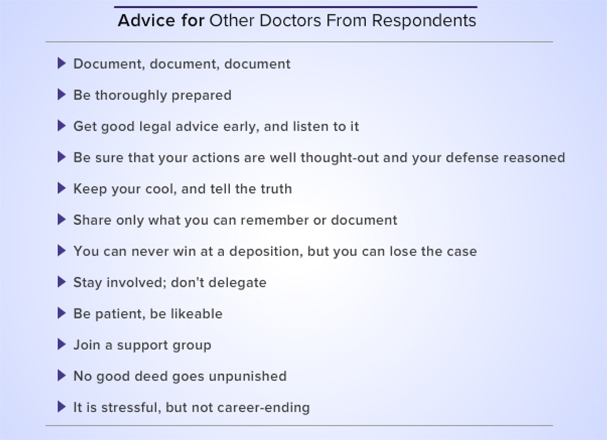
 Being sued by a patient who had a poor outcome is one of the more unpleasant experiences most doctors can contemplate. The impact of a malpractice lawsuit can be potentially devastating to one’s financial, professional and personal well-being. But it is not often that bad. In a survey conducted by Medscape among 4,000 physicians (Peckham C. Medscape Malpractice Report 2015: Top Reasons Doctors Get Sued—Anesthesiologists. January 22, 2016), the responding anesthesiologists reported that trial resulted in a verdict for the plaintiff in only two percent of cases. Another 33 percent were dismissed either by the court or by the plaintiff. Twenty-four percent were dismissed from the suit either before any depositions were taken or within the first few months. Forty-one percent settled before reaching the verdict stage, and 10 percent resulted in a verdict in the anesthesiologist’s favor.
Malpractice litigation usually ends in the anesthesiologist’s favor or with a settlement that is...
Being sued by a patient who had a poor outcome is one of the more unpleasant experiences most doctors can contemplate. The impact of a malpractice lawsuit can be potentially devastating to one’s financial, professional and personal well-being. But it is not often that bad. In a survey conducted by Medscape among 4,000 physicians (Peckham C. Medscape Malpractice Report 2015: Top Reasons Doctors Get Sued—Anesthesiologists. January 22, 2016), the responding anesthesiologists reported that trial resulted in a verdict for the plaintiff in only two percent of cases. Another 33 percent were dismissed either by the court or by the plaintiff. Twenty-four percent were dismissed from the suit either before any depositions were taken or within the first few months. Forty-one percent settled before reaching the verdict stage, and 10 percent resulted in a verdict in the anesthesiologist’s favor.
Malpractice litigation usually ends in the anesthesiologist’s favor or with a settlement that is...
3315 Hits
One of the biggest takeaways from the ASA Practice Management Conference held in San Diego on January 29-31 was the need for anesthesiologists to start thinking about what the Medicare and CHIP Reauthorization Act of 2015 (MACRA) will mean for their practices.
Physicians are already benefiting from the MACRA provisions that repealed the Sustainable Growth Rate (SGR) formula that would have driven Medicare payments down dramatically had Congress not overridden it every year. Instead of a 27 percent SGR cut that would have been implemented on April 15, 2015 absent the legislation, payments increased by 0.5 percent on July 1st. They were to increase again by 0.5 percent on January 1st of this year but adjustments for budget neutrality and a target reduction for allegedly misvalued codes in each of the next three years caused them to decrease by 0.2 percent.
Beyond 2016, MACRA provides for 0.5-percent conversion factor increases in 2017-2019...
3312 Hits
The Medicare requirement that eligible professionals and hospitals demonstrate “meaningful use” (MU) of electronic health record (EHR) technology has received a lot of attention from provider organizations and in the media recently. Two significant MU developments have occurred in the last few weeks: (1) the Centers for Medicare and Medicaid services (CMS) launched a streamlined process for claiming a hardship exemption and (2) CMS Acting Administrator Andy Slavitt stated publicly that the MU program “will now be effectively over and replaced with something better.”
Before explaining those two events, let us first assure readers that the MU program has not changed as far as its impact on anesthesiologists is concerned: all physicians with the specialty designation “anesthesiology” (“05”) in the Medicare Provider Enrollment Chain and Ownership System (PECOS) continue to benefit from an automatic exemption from the MU requirements. Let us remind you, too, that any physician who satisfies the MU requirements...
3178 Hits
Anesthesia Business Consultants (ABC), a leading provider in billing and practice management for the anesthesia and pain management specialty, is pleased to announce it will be attending PRACTICE MANAGEMENT 2016 hosted by the American Society of Anesthesiologists, held January 29-31 at the San Diego Hilton Bayfront in San Diego. This event is the premier business event for physician anesthesiologists and practice administrators.
ABC will be demonstrating its new anesthesia-specific ICD-10 documentation application, F1RSTCode. Unlike other apps in the industry that are not specialty-specific, F1RSTCode assists anesthesia providers in understanding documentation requirements without burdening them by requiring a search through the entire ICD-10 code sequence.
In a very logical and intuitive way, F1RSTCode takes you from the surgical procedure through the logic of ICD-10. It not only provides invaluable guidance for documenting the diagnosis, but will also provide a framework for discussing the post-operative diagnosis with the surgeon during the post-op time out.
PRACTICE...
2729 Hits
 The past several years have, once again, brought major changes to the anesthesia community and have greatly impacted private practice anesthesia. Whereas the early nineties were a time of “anesthesia surplus” when anesthesiologists struggled to find opportunities paying as little as $100,000, those days were followed by a shortage of anesthesia providers. Supply and demand economics dictated that during the days of anesthesia staffing shortage, prices and compensation for anesthesia staff increased to the highest levels in history. Now, a new day is on the horizon where hospitals have many choices for anesthesia coverage. Smaller, private practice anesthesia groups struggle to sustain financial viability. Many groups are exploring mergers to achieve economies of scale and hoped-for negotiation leverage with private payers. Larger and mega-groups continue to liquidate their value and sell to publicly traded companies such as EmCare or MedNax. A growing number of large anesthesia staffing companies continue to enter...
3177 Hits
