All physicians, group practices and other providers who participate in Medicare are required to resubmit and recertify the accuracy of their enrollment information every five years through a revalidation process.
Section 6401 (a) of the Affordable Care Act established new screening requirements for providers; required them to be revalidated under those new requirements, and reinforced the revalidation regulations at 42 CFR §424.515. The first cycle of enrollment revalidations ended as the second cycle began in March 2016.
Required Actions
Physicians and other clinicians must submit their revalidation applications by the last day of the month in which they are due. Your Medicare Administrative Contractor (MAC) is expected to notify you of the due date within two to three months of your revalidation deadline, by email or by regular mail. Generally, this due date will remain with you throughout subsequent revalidation cycles.
Centers for Medicare & Medicaid Services (CMS) also maintains a list...
2651 Hits
The ASA adopted its Statement on Principles for Alarm Management for Anesthesia Professionals at its annual meeting in October 2013. The introduction to the Statement provides as follows:
As Anesthesia Professionals, we interact with many different types of monitors, machines, infusion pumps and other equipment; many of these devices have audible and/or visual alarms. We rely on alarms to signal us when set parameters/ thresholds are violated and/or when a potentially abnormal situation has occurred. A given alarm’s clinical usefulness depends on numerous factors including attributes of the patient (e.g., baseline clinical status and vital signs), the clinical situation at the time (e.g., anesthetic and procedural factors), the intended recipient(s) (e.g., experience, hearing acuity), unintended recipients (who may be distracted or worried), and the physical environment (e.g., noise and light levels). Management of these alarms becomes challenging, especially in that we must rapidly discern when a trigger is trivial, meaningful or...
3024 Hits
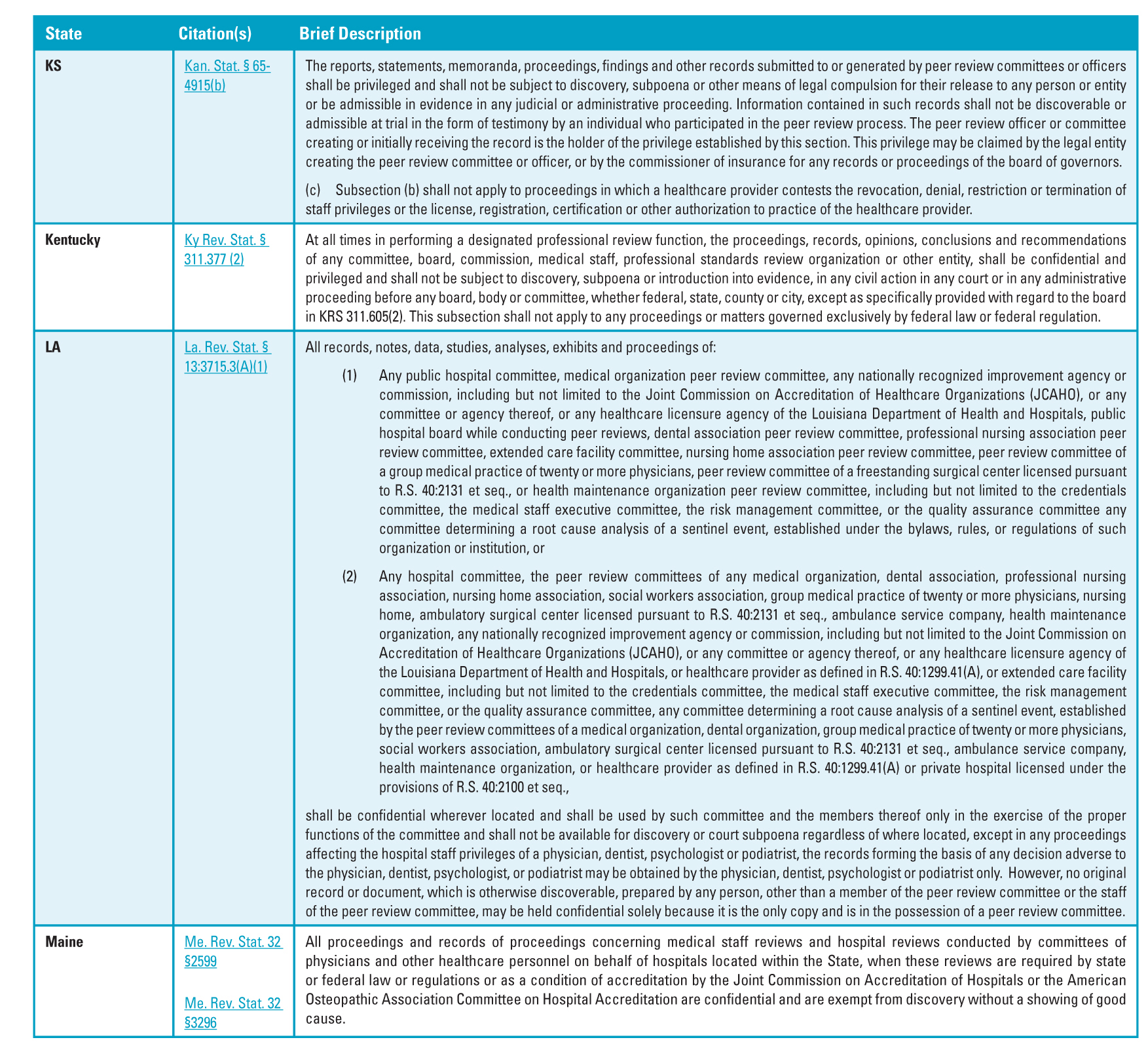 In the Winter 2016 issue of The Communique, we offered Part I of a summary of state laws (Alabama through Iowa) involving the peer review process. Here we are continuing that summary with the remaining states (Kansas through Wyoming).1
2615 Hits
Have you ever found that you could not make heads or tails of a Medicare regulation? Have you wondered whether even CMS could decipher and coherently apply its own rules? The sheer volume of regulations makes it difficult to be certain of one’s interpretation:
Medicare is, to say the least, a complicated program. The Centers for Medicare & Medicaid Services (CMS) estimates that it issues literally thousands of new or revised guidance documents (not pages) every single year, guidance providers must follow exactingly if they wish to provide health care services to the elderly and disabled under Medicare’s umbrella. Currently, about 37,000 separate guidance documents can be found on CMS’s website.
Caring Hearts Personal Home Services, Inc. v. Burwell (No. 14-3234) (10th Cir. 2016). Caring Hearts, a home health agency, had been ordered to refund more than $800,000 to CMS on the grounds that some of the physical therapy or skilled nursing services...
2345 Hits
 One of Robert Frost’s most popular poems is The Road Not Taken. It is about two paths that diverge in the woods. It is a wonderful and powerful metaphor for the decisions we make in life. By selecting one option we inevitably forgo another. More often than not this results in endless speculation as to whether it was the right choice. And so it is with the strategic decision to sell one’s anesthesia practice. The allure of being part of a bigger, stronger and better-managed entity is a powerful draw but does it really result in a more secure practice situation? That is the question of the day.
Anesthesia providers are a curious breed. They are credited with having the shortest decision cycle in medicine. They routinely make critical life and death decisions in a matter of seconds. Ironically, despite their facility in the operating room, when presented with major strategic...
One of Robert Frost’s most popular poems is The Road Not Taken. It is about two paths that diverge in the woods. It is a wonderful and powerful metaphor for the decisions we make in life. By selecting one option we inevitably forgo another. More often than not this results in endless speculation as to whether it was the right choice. And so it is with the strategic decision to sell one’s anesthesia practice. The allure of being part of a bigger, stronger and better-managed entity is a powerful draw but does it really result in a more secure practice situation? That is the question of the day.
Anesthesia providers are a curious breed. They are credited with having the shortest decision cycle in medicine. They routinely make critical life and death decisions in a matter of seconds. Ironically, despite their facility in the operating room, when presented with major strategic...
2814 Hits
