October 9, 2008
Did you or your group participate in Medicare’s Physician Quality Reporting Initiative (PQRI) in 2007? If you have not yet seen the official report on your individual and/or group participation, you may want to do so now. The Centers for Medicare and Medicaid Services (CMS) have posted participation reports on a secure website that physicians and their authorized staff may access through a special portal at http://www.qualitynet.org/pqri:
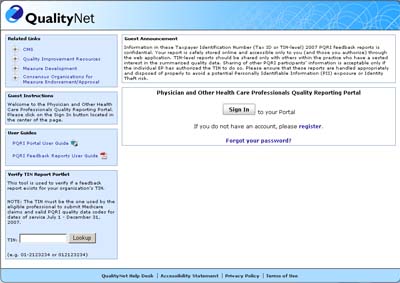
To register to see your confidential report, you will need a lot of numbers and a lot of patience, however. The PQRI payment—if any—was made to the practice, so the group’s Tax Identification Number (TIN) is indispensable. So are the Group UPIN, the individual physician UPIN and the National Provider Identifier (NPI). These numbers and other practice information will enable the physician—or rather, the primary and secondary “security administrators” that practices are required to designate—to register with the secure system known as the Individuals Authorized Access to CMS Computer Services (IACS) as a first step to gaining access to the confidential reports. For information on the other steps in the process, consult the PQRI Portal User Guide accessed through the link at the bottom left of the screen displayed above, and/or the respective Medicare Learning Network (MLN) Matters Special Edition articles for individuals and organizations:
- SE0830-- Steps for Individual Eligible Professionals to Access Their 2007 Physician Quality Reporting Initiative (PQRI) Feedback Reports Personally (http://www.cms.hhs.gov/MLNMattersArticles/downloads/SE0830.pdf), and
- SE0831-- Steps for Organizations to Access Their 2007 Physician Quality Reporting Initiative (PQRI) Feedback Reports (http://www.cms.hhs.gov/MLNMattersArticles/downloads/SE0831.pdf)
The process is unfortunately as complicated as it seems, and no one has yet found a way to simplify it for all users. An extremely sophisticated quality manager at one of ABC’s clients, with whom we worked yesterday afternoon to attempt to log on, said, “I think I could probably get into Fort Knox more easily.”
One physician interviewed for the article that appeared in the October 6 online edition of the AMA’s American Medical News was quoted to much the same effect: “You'd think you were getting CIA clearance.” According to the article (Medicare pay-for-reporting effort draws fire from frustrated doctors, http://www.ama-assn.org/amednews/2008/10/06/gvl11006.htm), which cited a survey released on September 8 by the Medical Group Management Association (MGMA), 93 percent of practices reported difficulty in accessing their PQRI reports.
Even for the physicians who saw the process through and found their personal PQRI reports, the results were sometimes mystifying. The PQRI payments were never intended to serve as the sole incentive for doctors to report the PQRI measures on their claims to Medicare, but the quality-improvement and educational incentive is also very much in doubt, given the state of the reporting system.
ABC joins the AMA, the MGMA and many other physician organizations in urging CMS to make the PQRI a tool that will truly help the profession in its efforts to bring quality to ever higher levels.